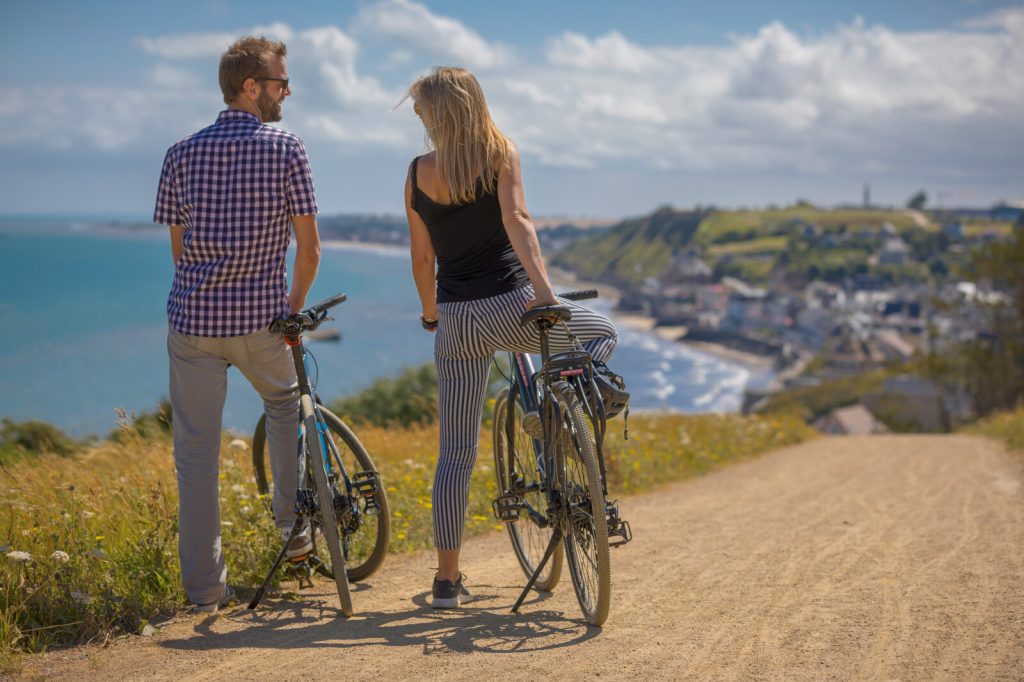
There are two ways to see the landing beaches. Most visitors take the first: a coach from Paris, three stops, twenty-five minutes at the American Cemetery, back on the motorway by four. Our D-Day tours in Normandy take the second. You stay on the coast for several days and cover it on foot or by bike — hotels booked ahead, luggage moved for you each morning, GPS route on your phone, and no timetable to follow but your own.
This page gathers what we have learned by riding and walking this shoreline season after season: what each of the five beaches actually holds, how to choose between walking and cycling, which trip fits which amount of time, and the practical details — trains, ferries, booking windows — that decide whether June works for you, or whether September works better.
Why walk or cycle the D-Day coast rather than drive it
A car crosses the invasion area in about an hour. That speed hides the one thing the ground can still teach: distance. On 6 June 1944, some 156,000 Allied troops came ashore along 80 kilometres of coast — five beaches, from the dunes of Utah in the west to the mouth of the Orne at Sword — while more than 18,000 airborne troops had already dropped inland in the dark. Eighty kilometres is abstract through a windscreen. After two days of pedalling, it is not.
You also get the hours the coaches miss. Omaha Beach at eight in the morning, tide out, sand hard and grey, is a different place from Omaha Beach at noon. Our clients tell us the same thing every season: what stays with them is not the museums but the ground between them — the lane that drops out of the hedgerows onto the sea, the first sight of the cemetery through the pines.
And the route network is genuinely good. The Vélomaritime — the French section of the EuroVelo 4 cycle route — runs the length of the landing coast, and west of Omaha it becomes a greenway along the clifftops of the Bessin. For us, the kilometres between Grandcamp-Maisy and the Pointe du Hoc are the finest of the entire coast, and in September you may have them to yourself. Walkers have their own thread: the GR223 coast path follows this same shore on its long way from Honfleur towards the Cotentin, in sight of the beaches for days.
The bus sees monuments. You see what separates them.
The five beaches, west to east
Each beach kept its code name, and each has kept its own character. Here is the coast as you would ride or walk it — and if you want the detail on individual sites, our guide to the ten places not to miss goes deeper.
Utah Beach
The westernmost beach is low and wide, backed by dunes rather than cliffs. More than 20,000 American soldiers and 1,700 vehicles came ashore here on the first day, onto sand flanked by marshes the occupiers had deliberately flooded. The Utah Beach museum now sits just behind the dune line at Sainte-Marie-du-Mont, and quiet lanes lead inland to Sainte-Mère-Église, taken by American paratroopers in the first hours of 6 June — the parachute caught on the church tower is retold there in every language. Our Normandy June 44 cycling trip ends its five nights right here.
Pointe du Hoc and Omaha Beach
Between Utah and Omaha, the clifftop at the Pointe du Hoc still carries the craters of the bombardment. On the morning of the landings, 225 Rangers under Lieutenant Colonel James E. Rudder scaled this 30-metre wall under fire, found the casemates empty, then tracked the guns down inland and disabled them. Stand on the edge for a minute. The plan reads differently from up here.
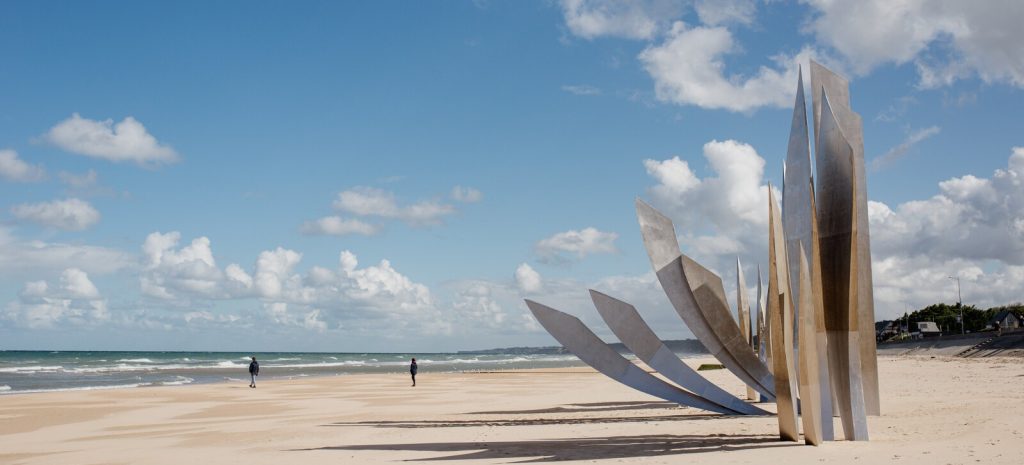
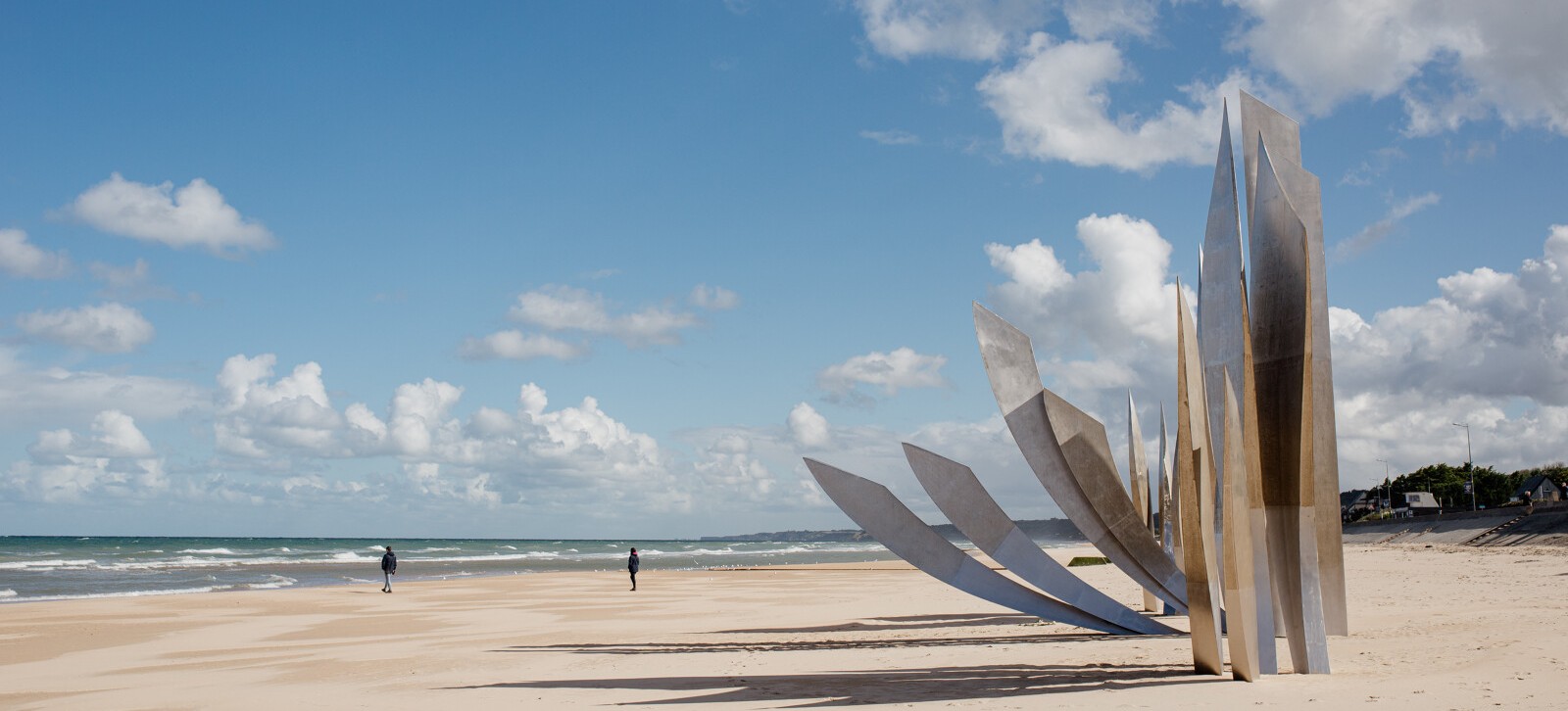
Omaha itself is a long, open crescent below bluffs, with the steel blades of the Les Braves memorial rising straight out of the sand at Saint-Laurent-sur-Mer. Above the eastern end of the beach, at Colleville-sur-Mer, the Normandy American Cemetery holds 9,389 graves in some 70 hectares of lawn, with 1,557 more names inscribed on the Walls of the Missing. Entry is free. Go early: before the car parks fill, the loudest sound is the halyard against the flagpole.
Gold Beach
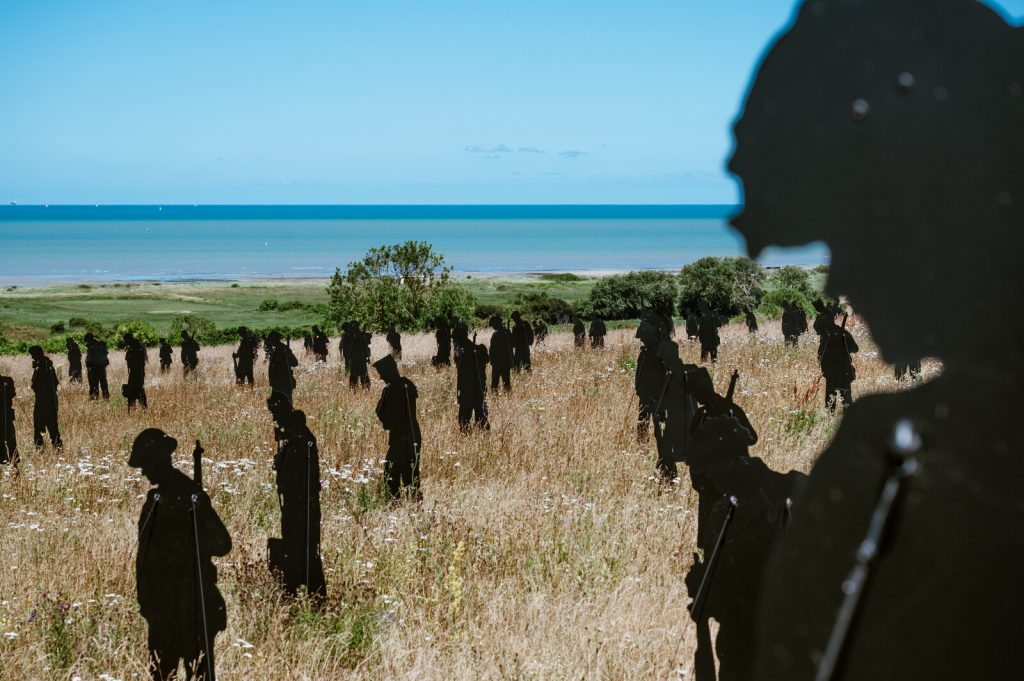
The British sector centres on Arromanches, where the concrete caissons of the Mulberry artificial harbour still break the sea in a wide arc — at low tide you can walk out towards them across the sand. On the hillside above Ver-sur-Mer stands the British Normandy Memorial, opened in 2021, recording the names of 22,540 men and women under British command who died on D-Day and in the Battle of Normandy that summer. It looks straight down onto Gold Beach, costs nothing to visit, and remains strangely calm compared with Omaha. Our five-day D-Day walk begins in Arromanches and works through this country to Bayeux.
Juno Beach
Juno was Canada’s beach, and Courseulles-sur-Mer keeps that memory in working order. The Juno Beach Centre — opened on 6 June 2003, and still the only Canadian museum on the landing coast — stands at the harbour mouth, and the seafront running east towards Saint-Aubin reads as one long promenade with the story set into it. Cyclists sleep well here: our long weekend on the landing beaches makes its first overnight stop in Courseulles, about forty easy kilometres out of Caen.
Sword Beach
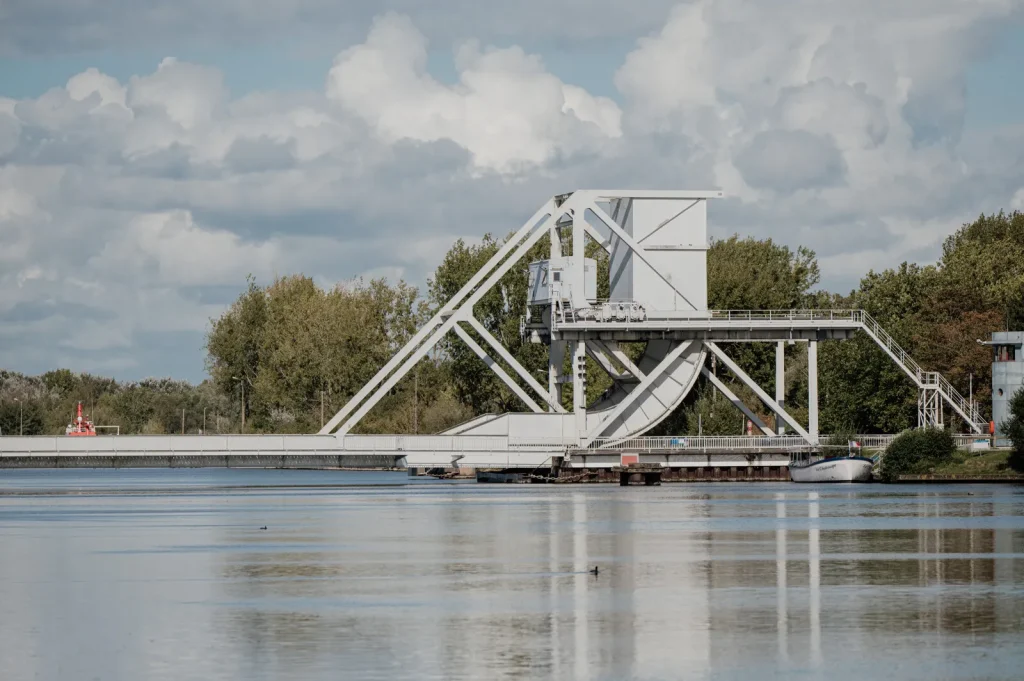
The easternmost beach has the strangest commute in Normandy: the ferry from Portsmouth docks at Ouistreham, so you can step off an overnight boat more or less onto Sword itself. A few kilometres inland, the bridge over the Caen Canal at Bénouville — Pegasus Bridge — marks where six Horsa gliders put down 181 men under Major John Howard in the first minutes of 6 June; both bridges were taken in about ten minutes. The Café Gondrée beside it, among the first houses in France to be liberated, still serves coffee to cyclists with cold hands.
Choosing your D-Day tour: on foot or by bike
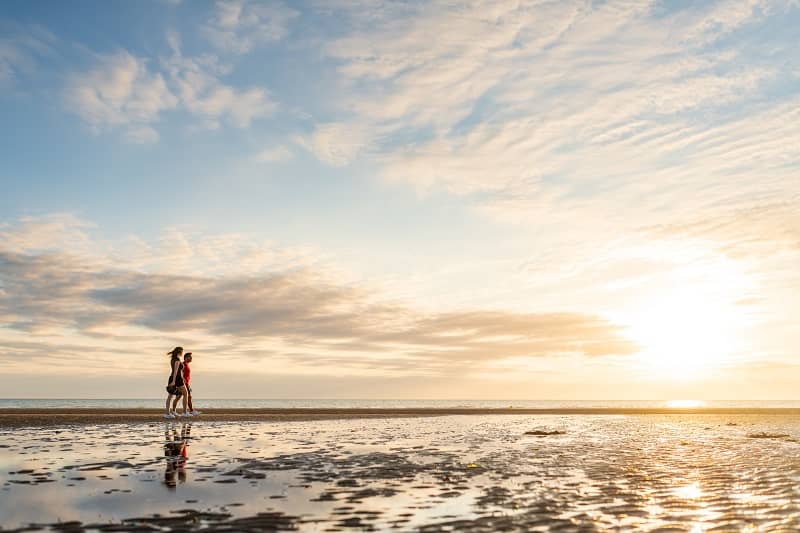
Both work. They make different trips.
Walking is the deep option. You take one sector and give it the time it asks for — the coast path, the lanes behind the dunes, the cemeteries reached quietly instead of through a car park. Our two walking itineraries hold to the heart of the coast: five days between Arromanches and Bayeux, or eight days that begin among the villas of Deauville and finish in landing country. Browse them on the D-Day beaches on foot page.
Cycling buys you the full sweep. Daily stages on the gentler itineraries run between 30 and 45 kilometres on mostly level ground, which leaves time for every museum and monument you care about — and the range goes from a three-day break to a week-long crossing. All six rides are gathered on the D-Day beaches by bicycle page.
| Trip | How | Duration | Route | From (pp) |
|---|---|---|---|---|
| WW2 Memories | Bike | 3 days / 2 nights | Bayeux → Caen | €260 |
| D-Day express | Bike | 5 days / 4 nights | Bayeux → Carentan | €470 |
| A long weekend on the landing beaches | Bike | 5 days / 4 nights | Caen → Bayeux | €490 |
| D-Day walk | On foot | 5 days / 4 nights | Arromanches → Bayeux | €505 |
| Normandy June 44 | Bike | 6 days / 5 nights | Bayeux → Sainte-Mère-Église | €600 |
| The road to Liberation | Bike | 5 days / 4 nights | Caen → Cherbourg | €690 |
| The road to Freedom | Bike | 7 days / 6 nights | Caen → Cherbourg | €850 |
| From the Flowery Coast to the landing beaches | On foot | 8 days / 7 nights | Deauville → Bayeux | €970 |
All prices are “from”, per person, as shown on each trip page. Our flagship ride:
The road to Freedom
How a self-guided D-Day trip works
Self-guided means the framework is ours and the days are yours. Concretely:
- Your route is prepared — GPS tracks and a detailed roadbook, on paths and lanes we ride and walk ourselves.
- Your hotels are booked — small, family-run places along the coast, chosen for where they sit on the itinerary.
- Your luggage travels without you — we move it to the next hotel while you are out; you carry a day bag and nothing else.
- Someone answers — local assistance seven days a week if a wheel, a knee or the weather argues with the plan.
There is no group and no guide. You go as a couple, a family, a handful of friends — and you stop when a place asks you to stop, which on this coast is often. A full walkthrough is in our guide to planning a self-guided D-Day tour.
Getting there, and when to go
Without a car, easily. Direct trains link Paris Saint-Lazare to Bayeux in just over two hours, several times a day. From the UK, Brittany Ferries sails Portsmouth–Caen (Ouistreham) in around 5¾ hours and Portsmouth–Cherbourg in around 3 — and since our two Caen–Cherbourg rides begin at one ferry port and end at the other, British riders can do the whole thing boat-to-boat.
Season. Most of our D-Day trips run from March or April to November. May gives you hawthorn in the hedges and empty museums; June carries the commemorations and their crowds; September and October are, in our view, the secret — soft light, warm sea air, and room to breathe at every site. The week of 6 June is extraordinary and full: accommodation along the coast is reserved many months ahead.
Booking. Travellers from North America typically reserve six to twelve months out; from the UK, January to April is the classic window for a summer departure. For a June 2027 trip timed to the anniversary, the honest advice is: open the conversation in autumn 2026.
Frequently asked questions
Can you visit the D-Day beaches without a car?
Yes. Take a direct train from Paris Saint-Lazare to Bayeux in just over two hours, or a ferry from Portsmouth to Caen-Ouistreham or Cherbourg. On a self-guided tour your luggage is moved between hotels for you, so once you arrive, the coast is covered entirely on foot or by bike.
How many days do you need to see the D-Day beaches?
Three days covers one sector properly — that is the format of our shortest cycling break. Five days at walking pace, or easy cycling pace, suits the heart of the coast between Arromanches, Omaha and Bayeux. To take in the full sweep from Caen to Cherbourg, allow a week.
Are the D-Day beaches free to visit?
The beaches are open public shoreline, and the major memorial sites — the Normandy American Cemetery, the British Normandy Memorial, the Pointe du Hoc — cost nothing. The museums charge entry: the Juno Beach Centre, the Arromanches landing museum and the Utah Beach museum among them. Plan and budget for two or three.
Which beach should you choose if you only have one day?
Omaha, for the cemetery above Colleville-sur-Mer and the Les Braves memorial standing in the sand, with the cratered clifftop of the Pointe du Hoc just to the west. If your family’s story is Canadian, make it Juno instead, and give the Juno Beach Centre at Courseulles-sur-Mer a full morning.
When should I book a D-Day tour for 2027?
For May or June 2027 — anniversary season — enquire six to twelve months ahead: the small hotels along the landing coast fill first, and their capacity is fixed. For a September or October departure, a few months’ notice is usually enough. A quote is free and commits you to nothing.
Ready when you are
The beaches will be there whichever month you choose; the rooms within sight of them will not. For June 2027, the coast starts filling by early spring — so if this trip is on next year’s list, request your free quote now and lock the framework in while the dates settle. Then one morning next year you will roll down a lane out of the hedgerows, the tide will be a kilometre out, and Omaha will be yours alone for an hour. That is the version of this coast we most want you to meet. Questions first? Write to us — a real person on this side answers, seven days a week.