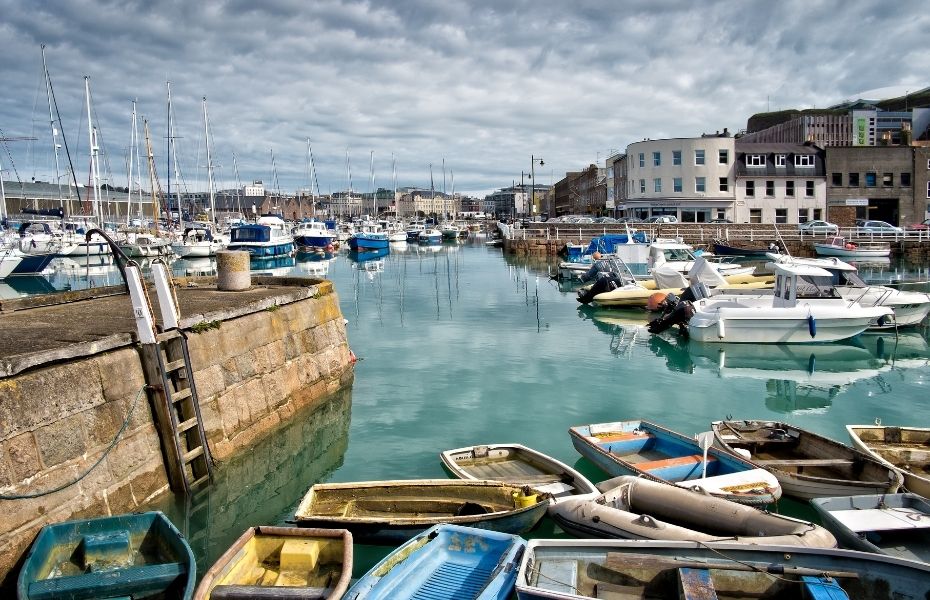
Jersey is the largest of the Channel Islands, which it makes up together with Guernsey. It lies in the English Channel close to France, and its capital is Saint Helier. It covers an area of 118.2 km2 and has a population of around 106,500 islanders.
Jersey, a British island
Jersey’s head of state (informally known as the Duke of Normandy) is the British monarch, currently King Charles III, who is represented on the island by a Lieutenant Governor.
Jersey is made up of the main island itself, along with its uninhabited reefs known as the Écréhous and the Minquiers and a handful of other uninhabited islets. Unlike the United Kingdom, which left the European Union on 30 January 2020, Jersey was never part of it.
Its culture is largely British. The pound sterling is the currency, and since the Second World War the everyday language of its people has generally been English. That said, there is a strong Norman influence here too. The island’s traditional language, for instance, is Jèrriais, a form of Norman.
Jersey is the second closest of the Channel Islands to France, lying just 22 km off the coast.
Saint Helier is the island’s capital, and its shopping capital too! Fashion, jewellery, design, antiques: the town centre and its markets, with their Victorian atmosphere, are a must for anyone who loves to shop.

Getting to Jersey
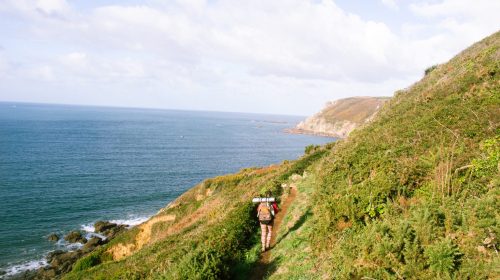
Nicknamed the Island of Flowers, Jersey offers a wonderful variety of landscapes, beaches, coastal paths, quiet country lanes and charming villages. With more than 60 km of dedicated routes, it is a paradise for anyone who loves walking or cycling.
From Saint-Malo or Granville, hop aboard a ferry and reach Saint Helier in 1 hour 15 minutes. You might even be lucky enough to spot dolphins or seals along the way.
Depending on the time of year, there can be as many as 47 crossings a week.
Walking and cycling in Jersey
From Saint Helier, there are plenty of routes to choose from. You could head out to Corbière Point on the west of the island, for example, by following the old railway line. Hugging the coast, this greenway then joins a small road that takes you to St Ouen’s Bay, before reaching Grosnez Castle (the name means “grey point”) in the north-west of the island. From there you can make your way towards Greve de Lecq, where you can enjoy some family time on the beach.

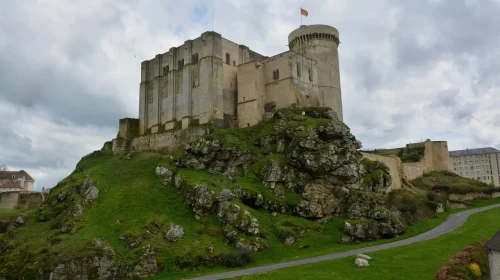
The road then climbs a little and draws closer to the cliffs along the island’s north coast. Mont Orgueil, the castle and the Royal Bay of Grouville are the high points of the route, offering sweeping views over the French coast and the other Channel Islands.
A small lane through the fields then leads back to Saint Helier, a chance to discover another side of the island with its cultivated fields, grazing cattle and old farmsteads.
Jersey in the warmer months
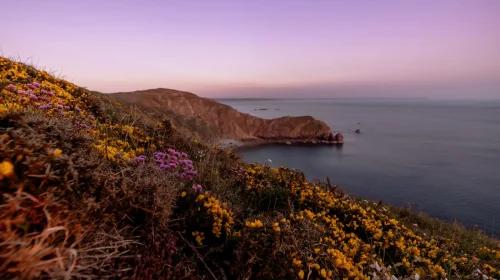
If you visit Jersey in the warmer months, you will soon understand how it earned the nickname Island of Flowers. You can explore Judith Quérée’s Garden, where more than 2,500 species of flowers are grown, or the Lavender Farm, a family-run distillery, or the Eric Young Orchid Foundation, where you can admire dozens of different orchid species.
And if you happen to be in Saint Helier in August, the Battle of Flowers is not to be missed. This carnival has been held since 1902. During the parade, each of the island’s parishes flies its colours with a flower-covered float.
Many would say that cycling is the most enjoyable and immersive way to discover Jersey. You can watch the hundreds of nesting bird species, several of which are rare elsewhere in the United Kingdom, such as the European serin and the little egret, as well as the seabirds that nest on the cliffs, like the Atlantic puffin and the European shag.
With its network of greenways and miles of cycle paths, cycling is the perfect way to explore this one-of-a-kind island!

Food and drink in Jersey
Seafood is one of the island’s specialities: mussels, oysters, lobster, crab, spider crab and other shellfish.

Jersey Royal potatoes are grown only on the island and harvested in spring. They are cooked simply, with butter and herbs.
Jersey milk, from Jersey cows, is wonderfully rich. The Jersey is the only breed of cow allowed on the island. Sadly, there is no tradition of cheesemaking here.
Jersey beef, whose reputation needs no introduction.
Black butter, or “béur nièr”. It has nothing to do with butter at all: it is a kind of spiced apple and cider preserve.

Cider: another local product that islanders are proud of.
Bean crock (pais au fou) is a traditional thick Jersey soup made with peas and beans.
Jersey Wonders are a kind of knotted doughnut, very popular at island celebrations.
Traditional Jersey bread is baked between two cabbage leaves, which gives it its distinctive flavour.
The Jersey atmosphere
La Faîs’sie d’Cidre is a folk festival held in October. It celebrates apple growing and cider making. The festivities revolve around exhibitions, stalls, and arts and crafts competitions.
Local food washed down with cider, and traditional Norman and Channel Island music.
In the evening, do as the locals do and gather in one of the many pubs with their unmistakably British atmosphere!
Jersey has plenty of cycle paths across wonderfully varied terrain. Nature is never far away.
Jersey is full of wild, natural spaces where you can reconnect and explore the great outdoors. Get out on your bike and discover the island on two wheels!