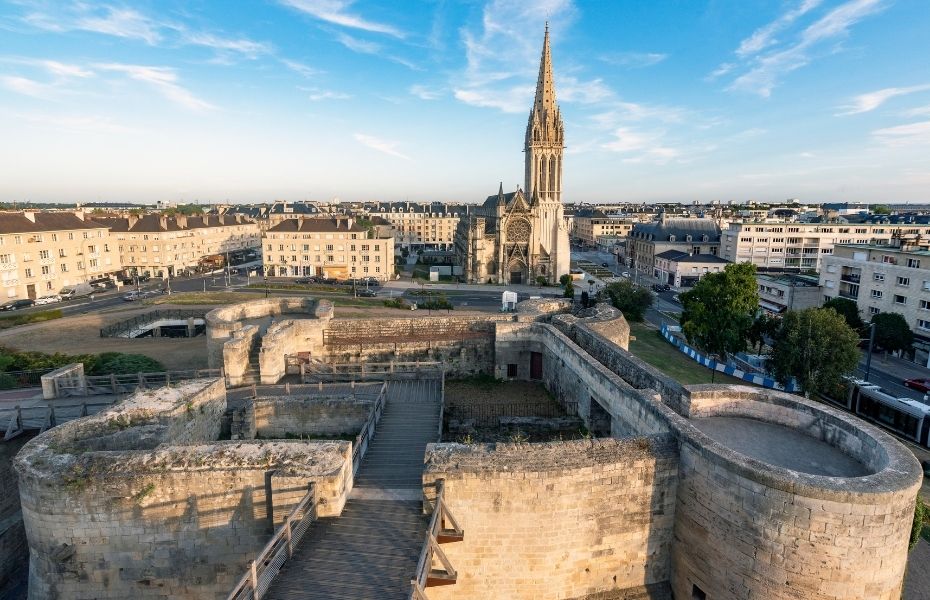
Set in the old heart of Caen, looking out over the lower Orne valley, Caen Castle is a vast walled enclosure flanked by square towers, covering around 5.5 hectares.
To the west and south, the rocky slope was cut away to make it steeper. To the east and north, a ditch was carved straight into the rock, separating the castle from the Vaugueux district and the surrounding countryside.
Caen Castle, the heart of William’s duchy
Caen is a textbook example of what is known as a ‘castle town’. Lying in a thriving farming plain, it was no exception to the rule and grew quickly along the banks of the Odon.
It was Duke William II of Normandy who made Caen the capital of his duchy. At the time it was little more than a cluster of villages, with no fortress or fortifications, so from 1060 he built a true citadel here, set apart by a ditch and commanding the lower Orne valley. The aim, for now, was simply to keep control of this growing town; its only gate, in fact, stood to the north.
But the duke had bigger ambitions. He wanted a secure base in Lower Normandy, and the site of Caen, close to the sea and roughly halfway between Rouen and the Cotentin, was perfect for his fortress. Building the castle and its two abbeys (the Abbaye aux Hommes and the Abbaye aux Dames) showed his determination to establish a second capital in the western part of the duchy of Normandy.
Normandy discovery
Caen Castle as a princely residence
Even so, the castle was already being criticised for its outdated defences, and it came to feel more like a princely residence where the duke-king could display his power and prestige. It would serve as a place of refuge throughout the Middle Ages, despite a position that left it exposed: overlooked to the north by the slopes where the university’s Campus 1 now stands, it was protected on that side only by a simple gate-tower in the wall.
In the 12th century Henry I, William’s son, dealt with this by building a square tower next to the gate-tower. It was effectively a castle within the castle, one of the many towers raised by the king of England.
The Exchequer Hall of Caen Castle
Around the same time, he also had a new Great Hall built, known today as the Exchequer Hall, fit for the splendour of the royal court. Henry II of England received the king of the Franks, Louis VII the Young, here twice, in 1158 and 1173.
A second hall of state was put up to the south-west of the great hall, on the esplanade overlooking the town, which was fairly unusual.
In the second half of the 12th century, English rulers lost some of their military interest in Caen Castle. Richard the Lionheart turned his attention instead to the Seine valley.
Later, John Lackland used the castle as a prison during his quarrel with his nephew Arthur of Brittany, shutting Arthur’s supporters away here.
In the early 13th century Philip Augustus, king of France, carried out major works to modernise the fortress, as he did elsewhere in the duchy, strengthening the defences to the north.
The square keep was surrounded by a broad curtain wall, with a powerful round tower at each corner, much like the Louvre, and set apart by a deep ditch. To the north the whole thing was doubled by another, equally steep horseshoe-shaped trench, creating a buffer zone known as the Roquette, or Garenne.
The coast of Calvados
Building the Mathilde and Puchot towers
From then on, access was from the east, through the fortified Porte des Champs. Two round towers were also raised where the castle met the town ramparts: the Tour Mathilde to the east and the Tour Puchot to the west.
From this point a single ‘captain of the castle and town of Caen’ was in charge of the place, bringing together two roles that had until then been kept separate.
Caen Castle was no longer a princely residence and royal visits became rare; Henry IV is thought to have been the last to stay here, in 1603.
What the castle kept above all was an important administrative role. Only the bailiff of Caen, the king’s representative, lived within the walls, in the King’s Lodging, known today as the Governor’s Lodging, which housed the bailiff’s private apartments, a private chapel, the bailiwick offices and a courtroom.
The Saint-Pierre Gate
In the 14th century, Caen Castle was pressed back into service during the Hundred Years’ War. The fortress became the linchpin of Normandy’s defence. It was at this time that the southern postern opening towards the town was turned into a proper fortified entrance, the Porte Saint-Pierre, and the barbican of the Porte des Champs was built.
Large-scale action took place from 1435, when the French began to reconquer Normandy, but by 1450 the castle had once again lost its strategic value: the keep was no longer maintained and the prisons were closed.
As a symbol of power, however, Caen Castle remained a target for anyone challenging the crown, so it continued to be adapted to new siege techniques. This is why François de Silly, bailiff of Caen from 1503, had the walls reinforced by piling thick masses of earth along the ramparts to better withstand the impact of cannonballs. Yet when the castle was bombarded during the first War of Religion, a breach was opened in the walls on the third day and the surrounded Catholics surrendered. Caen fell into Protestant hands.